
Country Club of Charleston
Alex Elias
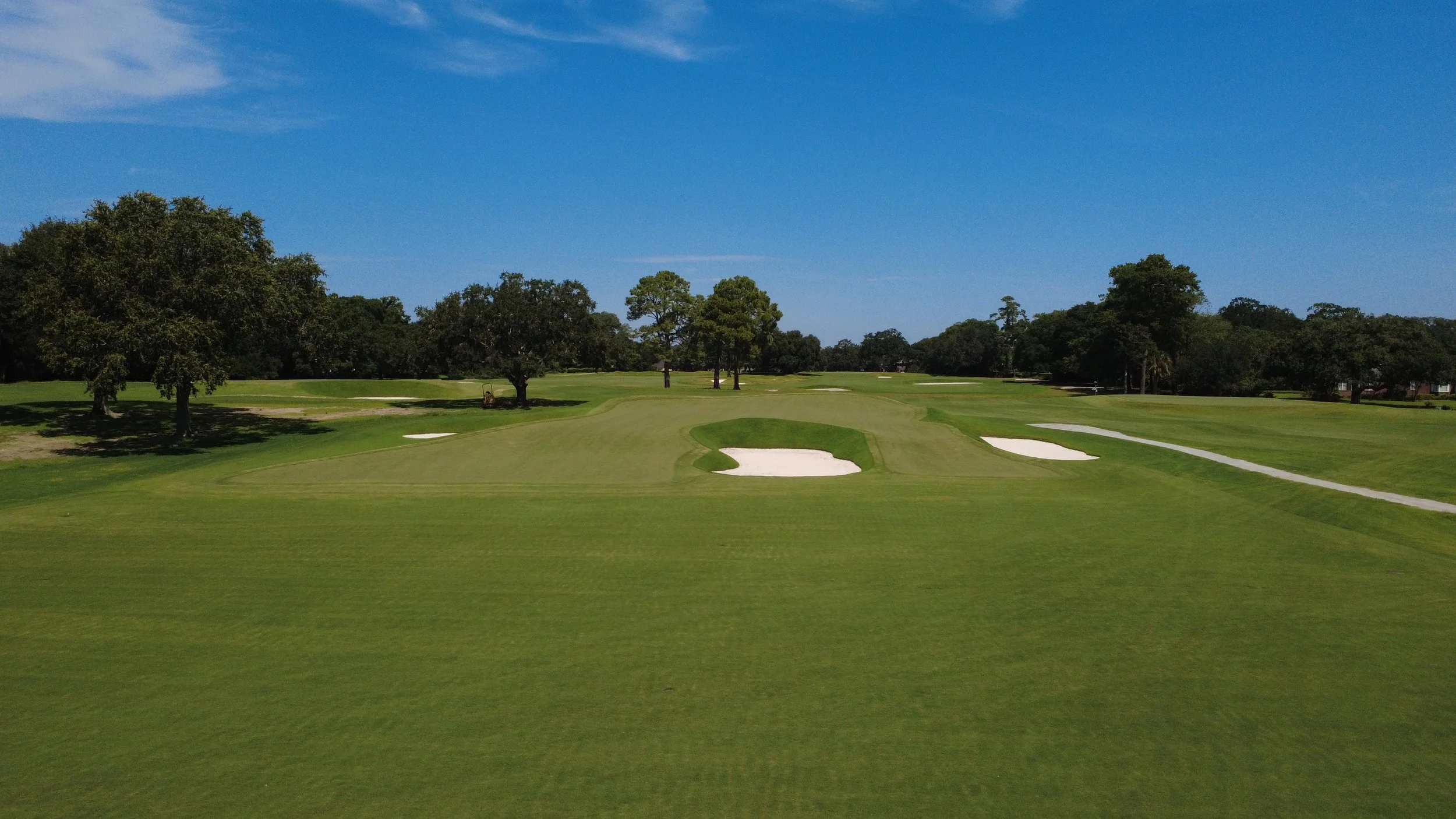
Courtesy of Country Club of Charleston
Designed from 1923 to 1925 by Seth Raynor, Country Club of Charleston has been restored over the years by John LaFoy (1990–1991), following the devastation of Hurricane Hugo; Brian Silva (2006), using photographs of the original course; and Kyle Franz (2016–2018), after the club uncovered more information on Raynor’s design.
Recently, Franz completed a new comprehensive restoration.
“Since I was hired in 2015, six holes have been restored, but to have the opportunity to restore the entire golf course to the way Raynor intended it to be played is a dream, and the scope of the restoration was as big as anything I’ve worked on,” said Franz. “To have the opportunity to study Raynor’s original plans—an aerial and a map printed in the local newspaper after Country Club of Charleston opened—was incredibly special.”
As some bunkers were lost over time, much the intended strategy had diminished.
By reinstating lost bunkers, much of Raynor’s strategy has been restored. For example, on Hole 2, “Valley,” players are faced with a much greater risk-reward opportunity given the extended bunker on the left.
“Previously, golfers didn’t have to think much until they reached the green complexes,” said Matthew Bova, Director of Golf at Country Club of Charleston. “Now, golfers have options and have to think off the tee. On Hole 2, with the bunker extended and angled a little more, the fairway pinches in on the left. Players must decide whether to challenge the narrower left side, leaving a shorter approach with a better angle, or play it safe out to the right—10–15 yards wider—leaving a longer approach.”
Although Country Club of Charleston has long been recognized as having the finest Lion’s Mouth green complex, and perhaps the boldest rendition of the Redan template, both were restored.
On Hole 11, Franz added an aesthetic bunker short of the green, as is traditional with the template, and recontoured the green to allow golfers to feed as far right as possible.
On Hole 16, the Lion’s Mouth green complex was restored using a photograph found by a member.
“The photograph was taken from the left-center of the fairway, about 40–50 yards out, looking directly at the Lion’s Mouth, in which a golfer and caddie were on the green,” said Bova. “To restore the back edge of the green, Kyle had a member of his team stand on the green, to match the historical height to a tee.”
In addition to restoring the back edge, the front of the green was restored. As the green previously extended the same distance on both sides of the bunker, the left side now flares out and extends farther, featuring a more severe false front.
“Hole 16 is one of Raynor’s finest holes ever,” said Franz. “And now it has been restored exactly to its original design, with a usable front left pin.”
For years, Hole 18 has proved to be a conundrum. As a ditch originally cut into the fairway, the hazard is unrestorable as the hole has been lengthened. Though not a “perfect restoration,” Franz added three diagonal bunkers to mimic the defense of the ditch.
“I would describe 18 as a mix of two Raynor templates: ‘Bottle’ and ‘Strategy,’” said Franz. “Players can carry the diagonal bunkers on the left, or play safe off the tee to the right, but a poor angle to approach the green.”
As Country Club of Charleston has a rich tournament history, hosting The Azalea Invitational since 1946, the Club hosted the 2019 U.S. Women’s Open Championship and will host the 2028 USGA Mid-Amateur Championship.
“We have a long tradition of supporting the game of golf,” said Bova. “Throughout the project, there was a point of emphasis to make the golf course harder for the better player, and easier for the club golfer, and I think Kyle succeeded in doing just that, which will be reflected in our everyday member and guest play, and our upcoming events.”
