
Jekyll Island Golf Club: Great Dunes
Alex Elias
Courtesy of Austin Kaseman (@austinkaseman)
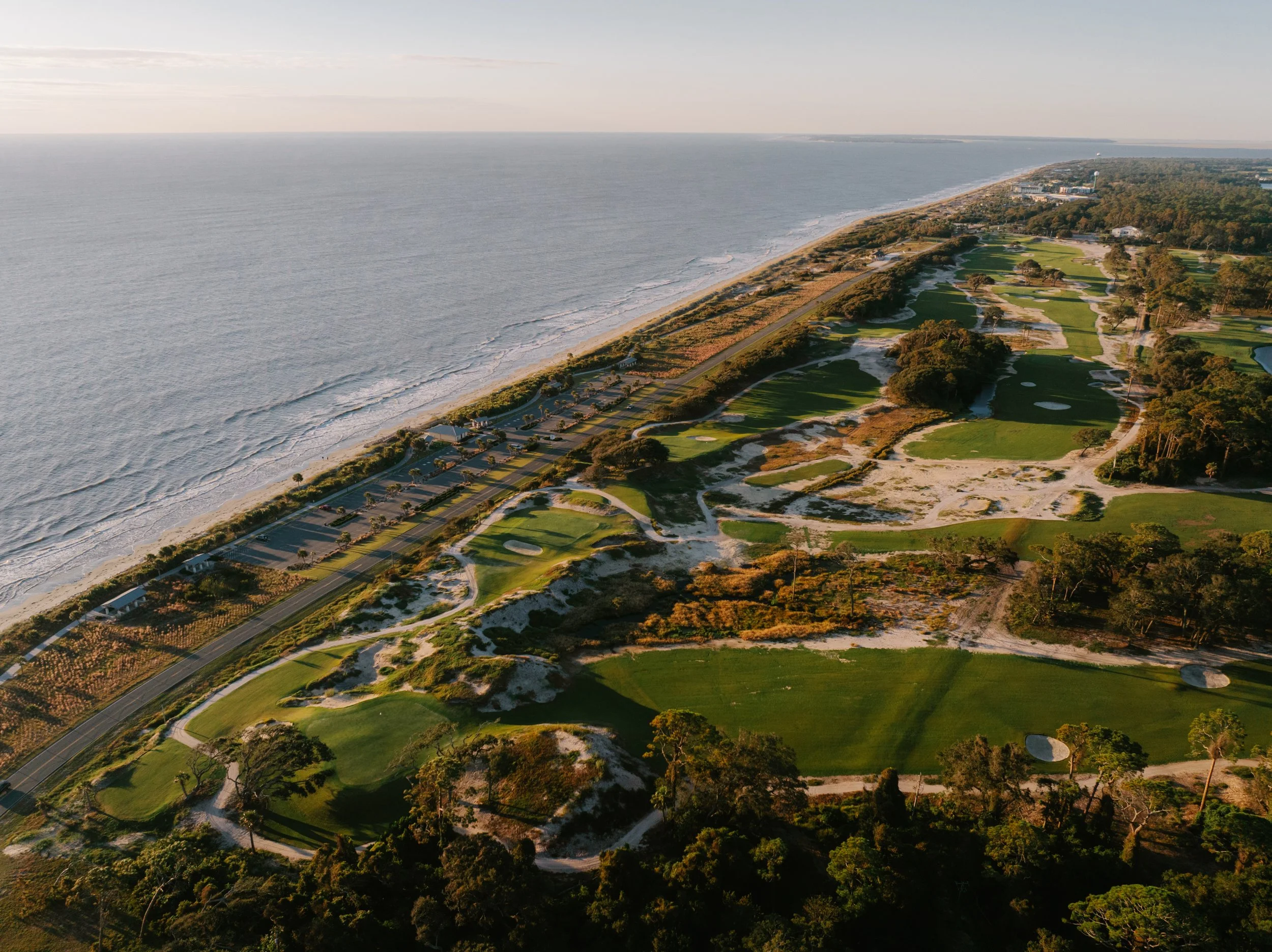
Originally designed by Walter Travis, Great Dunes was Travis’ final design, as he passed away before the course officially opened in 1928.
Now fully-restored by Brian Ross (Ross Golf Design) and Jeffrey Stein (Stein Golf Design), the project also included the creation of nine new Travis-inspired holes on a portion of the former Oleander Course to complete the new 18-hole Great Dunes Course.
“At the onset of the project, we knew that connecting the two distinctly different nines and their very different properties would be our biggest challenge. The Great Dunes nine had a very compact routing with limited cart paths, heaving sand dunes, green complexes that appeared to be found instead of built, and a windswept, shoreside aesthetic. In contrast, the Oleander Course, a Dick Wilson design from the 1960s, was routed through towering pines, massive live oaks, and around the large tidal estuary that bisects the island. It featured wall-to-wall cart paths, more separation between holes, tighter hole corridors, and clearly created green complexes,” said Ross. “Three primary decisions were made during the planning process that allowed us to seamlessly integrate these two nines into the cohesive 18-hole routing that exists today.
“The first, and probably most important, was choosing to create golf holes for the new nine that paid homage to Walter Travis’s design genius, rather than just creating nine new Ross/Stein-designed holes to pair with the nine restored holes. We poured through the Jekyll Island Archives to understand what the Great Dunes Course was like when it first opened in 1928—both on the nine we would be restoring and on the nine ‘lost’ holes eliminated in the 1950s.
“The second was choosing to jump into the middle of the Great Dunes nine to get golfers out to the ocean as early in the round as possible, and the final decision that really tied the course together was bringing the sandy aesthetic so beautifully presented in the 1928 version of the course into the inland holes so that it stays with the golfer throughout the entire round.
“We accomplished this by applying a beach-like theme to one of Travis’s hallmark design features—the ‘chocolate drop’ mound—and incorporating those throughout the routing.”
As Great Dunes now starts in the maritime forest, before venturing through the dunes and out to the ocean and back, Stein likened the routing to some of the finest courses in the U.S.
“Cypress Point, Friar’s Head, Maidstone, and Bandon Trails all do similar things with their routings in that the golf course travels through different micro-environments but also returns to the same place,” said Stein. “Each of these golf courses is an example of how the architecture can be elevated by highlighting and preserving the native plants and animals which give each golf course their defining characteristics.”
Courtesy of Austin Kaseman (@austinkaseman)
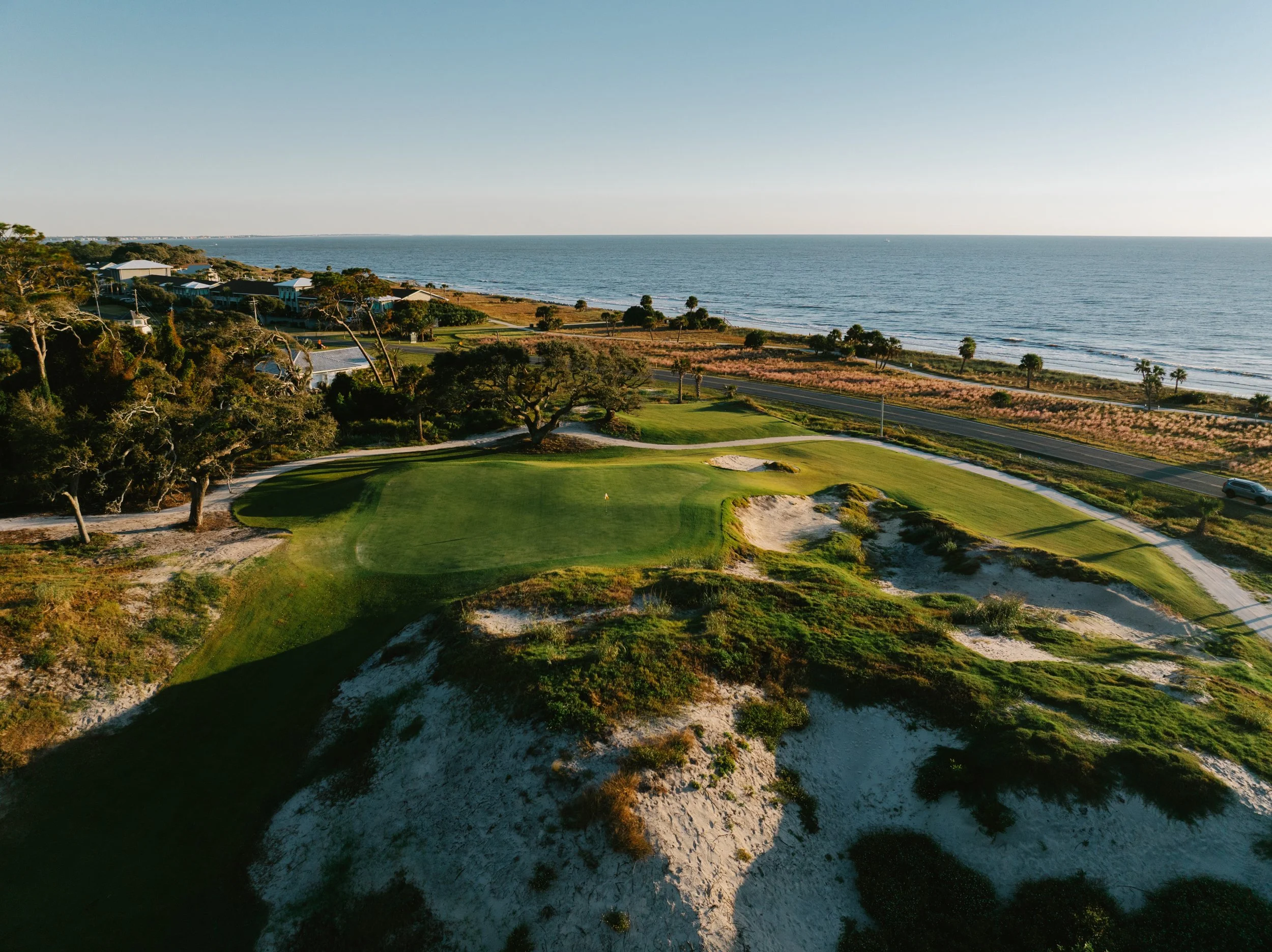
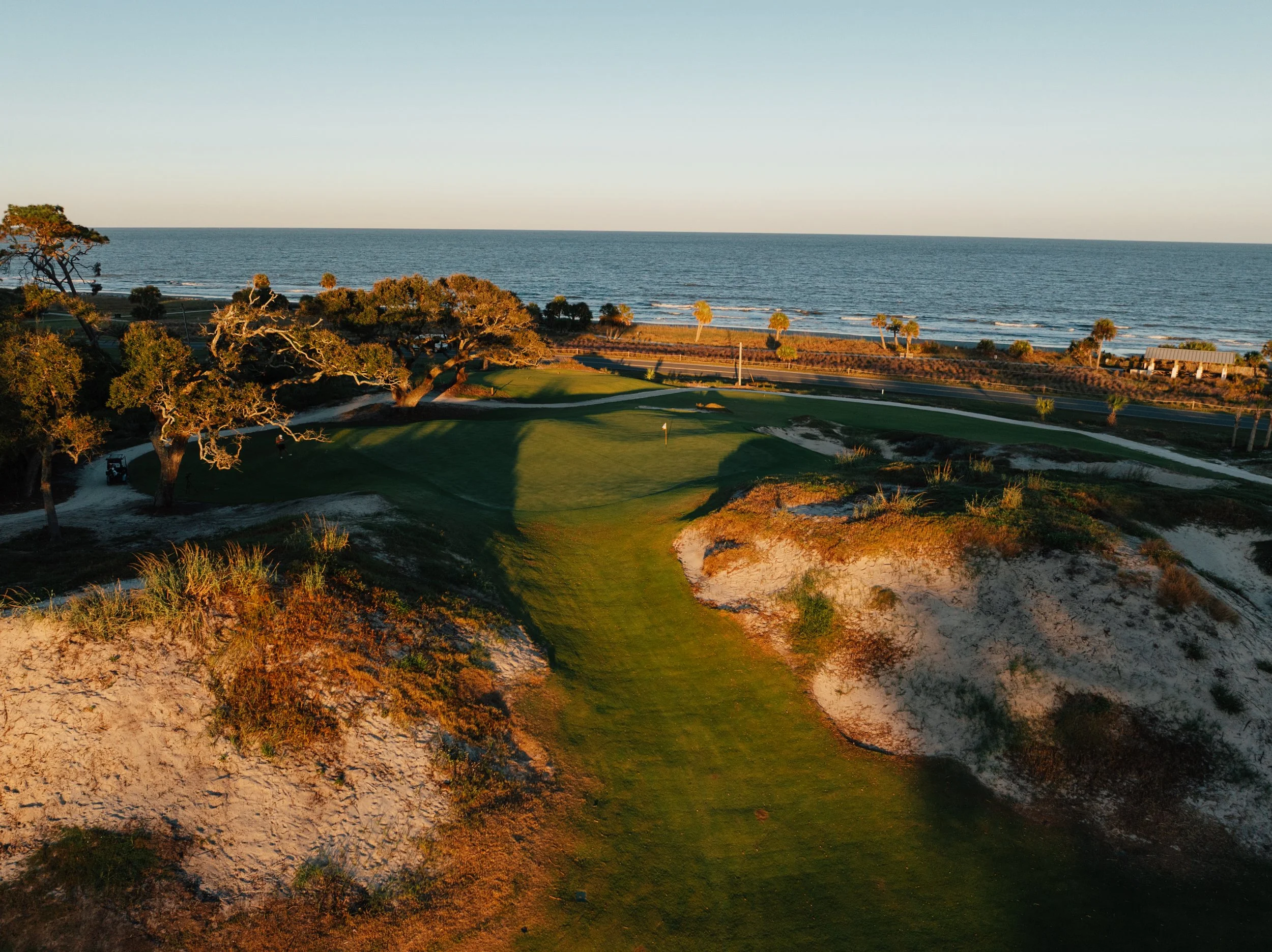
Beautifully restored, flanking dunes frame the elevated green on the Par-5 4th, known as “Mae West.”
“The 4th Hole is an incredible risk-reward Par-5 with one of the greatest green sites in American Golf, public or private,” said Ross. “The hole begins fairly benignly but builds to an amazing crescendo with the expanse of the Atlantic Ocean serving as the backdrop for an incredible approach shot. Here, golfers receive their welcome to the aptly named Great Dunes as two 40+ foot towering sand dunes, lovingly known as the ‘Mae West’ dunes, await to engulf a wayward second or third shot on this reachable Par-5.”
“If you have the distance a second shot approach to the green is tempting but comes with a high risk as the famous dunes known as “Mae West” guard the green on both sides, featuring steep slopes, thick vegetation and the footprints of deer and downtrodden golfers who have suffered the fate of their errant approaches,” said Stein. “The smart play is to lay up to a comfortable yardage, hit your approach through the narrow gap to the green, and attempt to make your birdie putt. You won’t want to spoil the view that awaits as you climb the dune and see the ocean for the first time!”
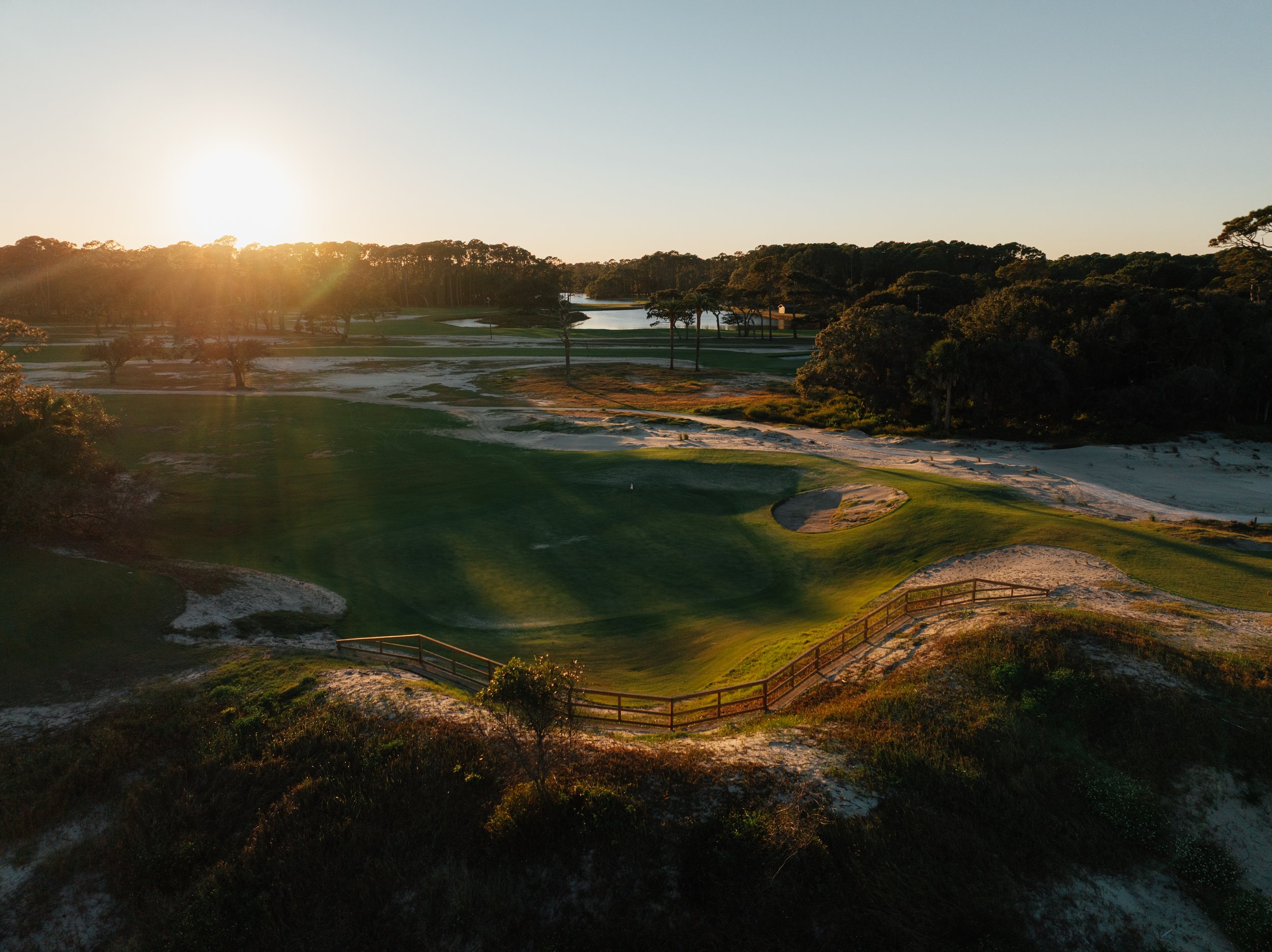
Similarly, the dogleg-right Par-4 10th, which plays to a green set into an amphitheater, was restored “almost exactly to its original dimensions thanks to archival ground-level photography.”
As for Travis-inspired holes, the Par-3 13th and Par-5 15th stand out. Inspired by the Par-3 14th—which sat on the far southern end of the property and, like the rest of the back nine, was destroyed and abandoned following a hurricane in the early 1950s—the Par-5 13th features a T-shaped green. Just as Hole 13 is reminiscent of a Travis green, so too is the 15th’s green, inspired by Walter Travis’ “bathtub” green.
Varying in size, the green complexes range from 5200 sf on the par 3 5th, to 12,000sf on the par 3 17th.
Varying in size, the green complexes range from 5,200 square feet on the Par-3 5th to 12,000 square feet on the Par-3 17th.
“Some were benched on top of dunes (4, 5, 11) and some were cut into the base (8, 10). Some were built on grade in the plain (6, 9) and some were built up (7, 12). This is no surprise, really. Travis was one of, if not the best, green builders of the Golden Age so we knew we'd have our work cut out for us to build nine new greens capable of standing alongside his nine,” said Ross. “We tried to infuse this same individuality and variety into our new greens and, using the photographic evidence from the "lost" nine as well as our experience visiting dozens of other Travis courses throughout the US and Canada, did our best to emulate greens we thought he would've built. I hope that golfers who have experienced his work elsewhere can see the similarities when they play the Great Dunes. From my perspective, I certainly believe this is the best set of greens we've built to date and I think "The Old Man" would be proud!”
“There is a wonderful variety to the putting surfaces which keeps the round of golf interesting to say the least. No two greens are even remotely alike and the prominent features which define each greensite provide wonderful short game and shot making possibilities on every approach. Nearly every green is surrounded by tightly mown turf which brings out the linksy nature of this sandy site,” said Stein.
Now open for nearly a year, Great Dunes remains especially significant as one of the few Travis-designed courses open to the public, offering rare access to Golden-Age architecture.
“Travis designed 50+ golf courses, and only five of them offer public access. With every tee time at Great Dunes open to the public, the opportunity to experience his work is incredibly rare,” said Stein.
Courtesy of Austin Kaseman (@austinkaseman)
“Of all the great ground-level photography we had of the Great Dunes Course after its opening in 1928, nothing intrigued me more than two photographs showing a narrow wooden walkway benched into a dune high above the amphitheater setting of what would become our 10th green. The tee box for the 11th hole sat high above and behind the 10th green, but both it and its wooden walkway had been abandoned decades earlier. We just had to restore this feature. I’m so proud of how this work turned out and how much it improved both the 10th and 11th holes,” said Ross.
