
Wicker Point Golf Club
Alex Elias
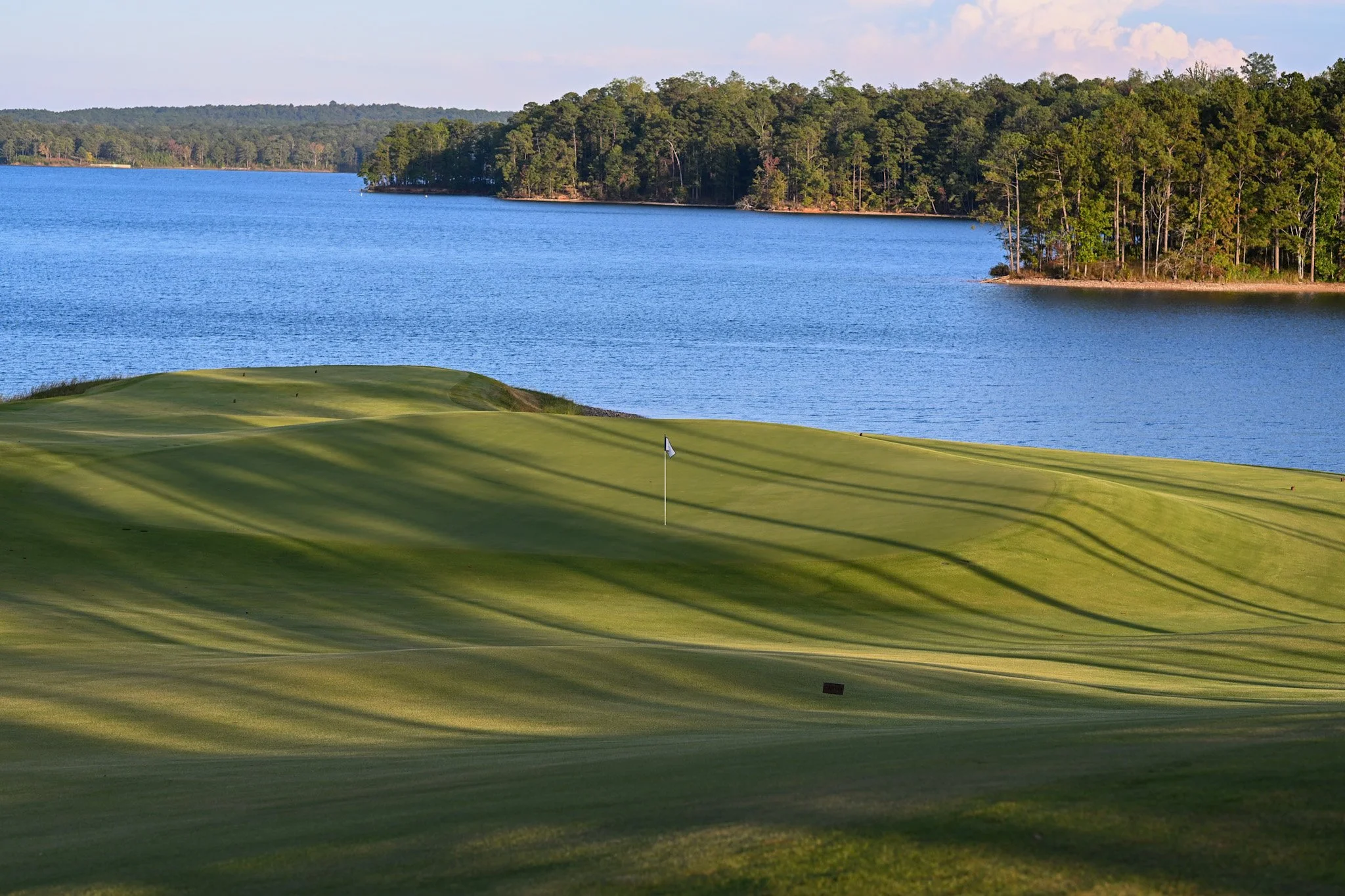
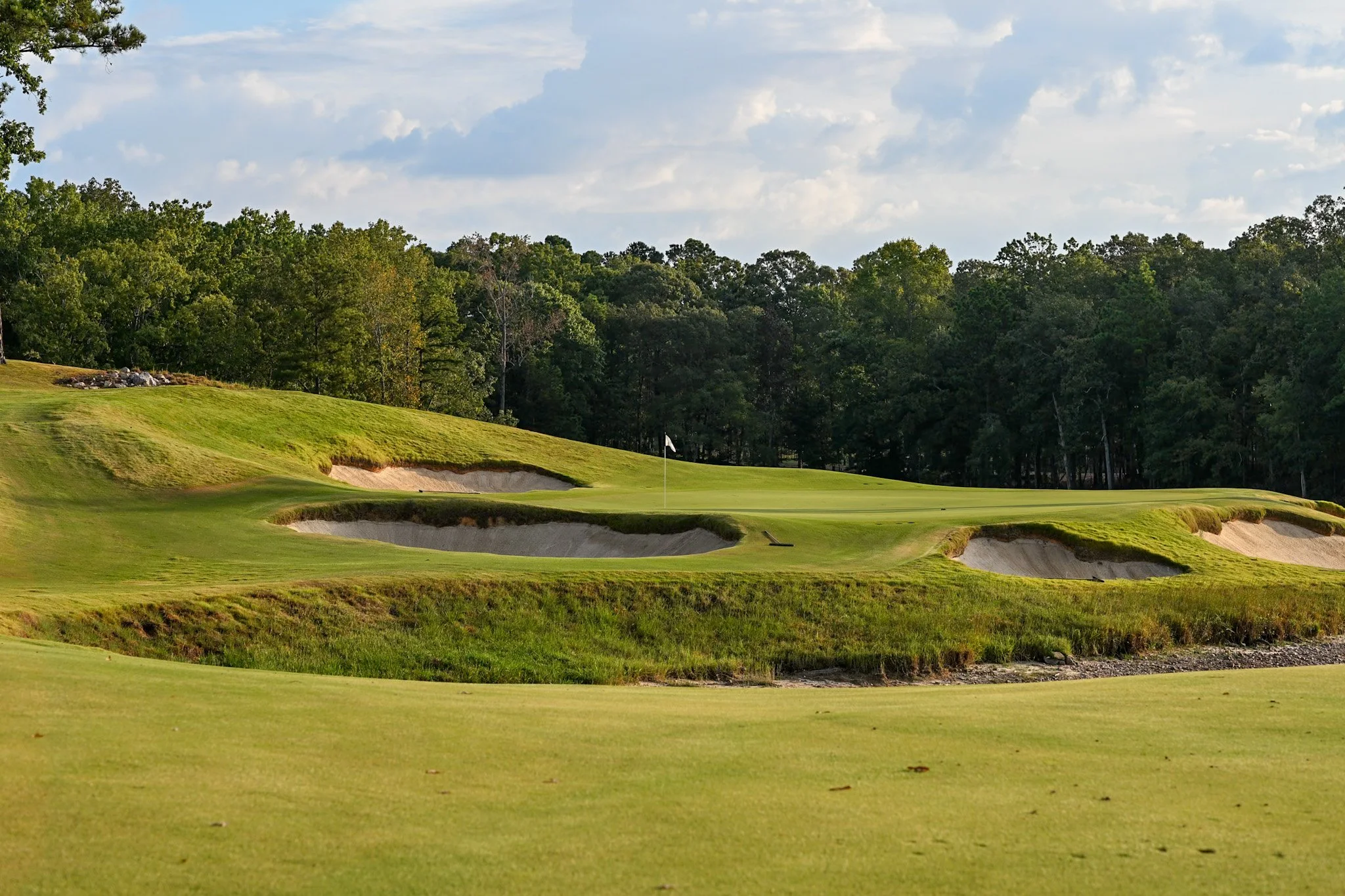
The duo behind Sand Hills Golf Club, Friar’s Head, Old Sandwich Golf Club, and others, Bill Coore and Ben Crenshaw are renowned for their minimalist design philosophy—one that emphasizes natural landforms and features, and organic routing over dramatic earthmoving. That approach ultimately shaped the routing of Wicker Point Golf Club. Originally, the course was envisioned for a different site—farther from the lake and higher up the mountain—but as Russell Lands Director of Golf & Membership Matt Sheppard recalls, Coore remarked, “We are not in the business of building vistas; we’re in the business of building golf courses.”
“Because of that decision, with the present-day routing, Bill and Ben were able to achieve what I believe they do best—design a modern course that looks as if it’s been there for a hundred years,” said Sheppard.
While the beauty of Lake Martin—one of the largest man-made lakes in the United States—naturally draws attention, the course is routed through three distinct environments: Young Pine Plantation (Holes 1–3, 9–10, 14–15), Creekside (Holes 4–7), and Lakeside (Holes 8, 11–13, 16–18). Although it was important to Russell Lands to showcase the lake, Coore and Crenshaw were intent on not creating any manufactured holes—staying true to their philosophy—which ultimately led to the Par-4 3rd and Par-4 4th becoming the first holes they discovered on the property.
“I remember Bill and Ben finding the third green site—a very benign hill with some subtle slopes around and behind it—and immediately saying, ‘This looks like golf,’” said Sheppard.
From there, the 4th was discovered, as Sheppard recalled Crenshaw saying, “If we can use the creek the way we want to, Bill believes we won’t see another golf course designed this close to natural wetlands anytime soon.”
Able to use it as they wished, the creek—now known as Little Ben’s Creek, named after Ben Russell of Russell Lands—begins to the right of the tee, cuts across to the left, then moves back to the right, protecting the front of the green and wrapping around behind it.
“From a visual standpoint, it’s not like some other courses where the banks roll uniformly into the creek—the creek is raw here, consistent with the bunkers and shorelines throughout the course,” said Sheppard. “From a strategic standpoint, players must know where the pin is off the tee—especially if it’s tucked just behind the lone greenside bunker, which was added a year after the course opened. When the pin is behind the bunker, players should favor the left side, which brings the creek into play. Successfully challenging the trouble yields a shorter approach with a better angle to the green.”
Once the Creekside holes were discovered, the routing became much clearer. In particular, it became evident that the lake’s peninsulas—or more accurately, its coves and inlets—could be used for three Par-3s. Though some may question the inclusion of three Lakeside Par-3s, each offers plenty of variety: The first (Hole 8) at 191 yards features a Reverse Redan-like green; the second (Hole 12) at 123 yards demands a wedge to a small green heavily guarded by bunkers; and the third (Hole 17) stretches to 180 yards, requiring a forced carry to a green shaped like a T-bone steak—angled so that the further back the pin is, the narrower the target becomes.
As for all the green complexes, Sheppard said, “They highlight one of Coore and Crenshaw’s greatest skills: restraint.”
Rather than dramatic shaping—with severe internal contours—Coore and Crenshaw relied on the sweeping movement of the fairways to blend seamlessly into the greens. Within those natural subtleties, a gentle tilt—like the one to the right of the green on the Par-4 2nd—can feed the ball toward the pin. But those same subtleties can just as easily repel shots, as on the Par-4 16th, where a slightly elevated, bunkerless green falls away into tightly mown runoffs.
“In both cases, their understanding of contours challenges the player to think. On 2, the decision comes from the fairway, while on 16, it’s greenside—where players must decide whether to flop a lob wedge, chip it low with a gap wedge into the slope, putt it with a putter, or even bump it with a fairway wood,” said Sheppard.
Now, having been open for two years, next-door Willow Point Golf & Country Club is currently undergoing a renovation overseen by Fry/Straka Global Golf Course Design, expected to re-open in Spring 2026.
