
The Walsh Family: Paul “Chet” Walsh
Alex Elias
Founded in 1897 by members of the Belmont Golf Association (now Aronimink Golf Club), Merion Cricket Club (now Merion Golf Club), Philadelphia Country Club and Philadelphia Cricket Club, the Golf Association of Philadelphia (GAP) is the oldest state/regional association in the country.
Throughout its 125-year history, many of America’s—and the world’s—top amateurs have had roots in the Philadelphia area.
Robert T. "Bobby" Jones, Jr. — Although Jones was born in Atlanta and grew up across the street from East Lake Golf Club, the 1916 U.S. Amateur at Merion Golf Club marked the first national championship appearance of the then-14-year-old, who went on to win his first National Amateur at Merion in 1924. Jones closed his international career winning the 1930 U.S. Amateur on Merion's eleventh hole. This was his fourth major win of the year (U.S. and British Amateurs and Opens) completing the never-equaled Grand Slam.
William Hyndman III — Born in Glenside, Pennsylvania, Hyndman finished runner-up in four amateur major championships, won the U.S. Senior Amateur twice—in 1973 and 1983—and was a member of five USA Walker Cup teams.
R. Jay Sigel — A charter member of the GAP Hall of Fame, Sigel won the U.S. Amateur twice, the U.S. Mid-Amateur three times, and earned low amateur honors in the Open Championship (1980), The Masters (1981–82, 1988), and the U.S. Open (1984).
“Best amateur since Bobby Jones hands down,” said Kevin Hammer, President of the USGA.
George Edward “Buddy” Marucci Jr. — Born and raised in Malvern, PA, Marucci has played in played in 59 USGA championship: 24 U.S. Mid-Amateurs; 23 U.S. Amateurs; six U.S. Senior Amateurs (2008 Champion); four U.S. Senior Opens; two Walker Cups; and two victorious Walker Cup captaincies.
If there’s one family that is synonymous with amateur golf in Philadelphia, though, it’s the Walsh family. Longtime members of Philadelphia Country Club, the late William “Bill” T. Walsh (1991 GAP Senior Amateur Champion; GAP President from 1991 to 1994) and his wife of 60 years, Barbara, had 15 children, one of whom, Paul “Chet” Walsh, is one of the finest amateur golfers the Philadelphia area has ever seen.
“Golf was instilled in my siblings and me at a very young age,” said Walsh. “Being the sixth of seven boys, my Mom always joked that from the day I was brought home, I was watching my siblings with their golf clubs in the backyard.”
Now sixty-one years old, Walsh won the 1995 Crump Cup at Pine Valley Golf Club, qualified for 10 USGA championships, and has won the Philadelphia Country Club Club Championship 14 times (Senior Championship five times).
“When I won my seventh championship, I decided to stop competing so I would not tie or pass my father,” said Walsh. “When he heard, he said, ‘A father always gets a lot more pleasure out of what his children accomplish than what he accomplishes himself.’”
As Chet’s sister, Tez Sieberlich, served as the General Chairperson for the 2003 U.S. Women’s Amateur Championship, Chet is set to lead a handful of committees (Player Reception/Registration, Locker Room, Driver Range) alongside Philadelphia Country Club Chairman Herb Miller, just as he did in 2005.
“I had actually hoped to qualify in 2005, but my wife and I welcomed our daughter on August 1, the day of the qualifier,” said Walsh. “It’s long been a joke within our family that when I decided to withdraw, I said, ‘She better be born before 5 PM, or else I could have played and made it back in time.’”
Nearly two decades after Philadelphia Country Club co-hosted the 2005 U.S. Amateur, Chet admitted this year’s championship carries even more meaning following Jim Nagle’s restoration.
“In Philadelphia, there's no debating that Pine Valley and Merion are #1 and #2,” said Walsh. “The conversation begins at #3, and while I’ve long thought Philadelphia Country Club deserves to be in that conversation, it does so even more now.”
“We continue to hear rave reviews, and we couldn’t be more excited to have the best amateur golfers in the world tested on our recently restored golf course.”
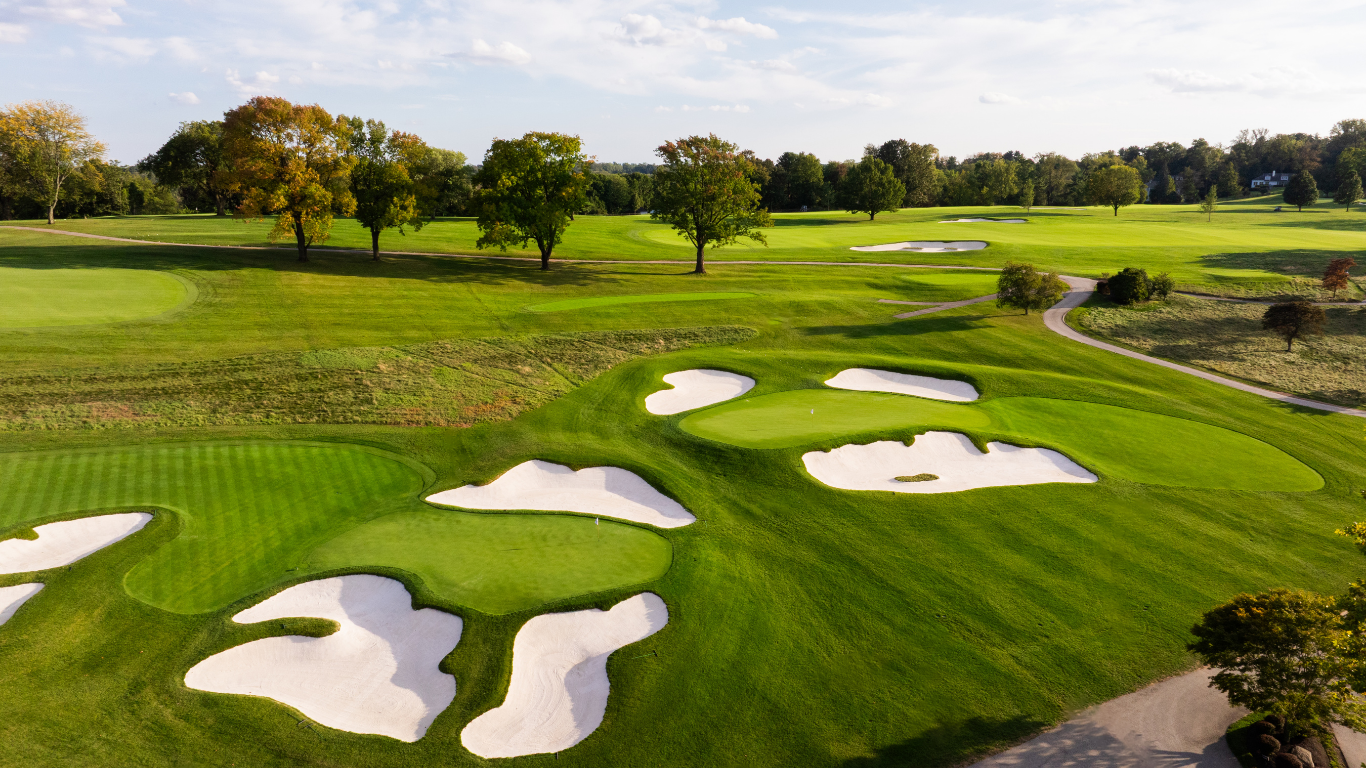
Though the restoration focused on restoring the bunkering and greens as accurately as possible using historic aerials and ground-level photos, along with letters to both the club and the USGA, Nagle also expanded the fairways.
“The fairways have been expanded, but the landing zones for tee shots still feel narrow,” said Walsh. “With many of the fairways sitting at an angle, as Flynn routed the golf course around the low middle valley and high ridge, players are demanded to not only hit a precise line, but also consider how far they are going to hit it.”
